
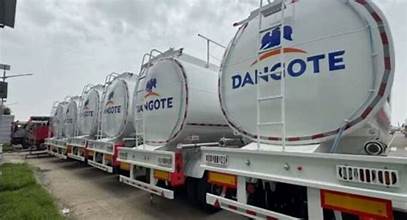
The Dangote Petroleum Refinery has started receiving 4,000 Compressed Natural Gas (CNG) trucks in phases ahead of launching its nationwide petroleum product distribution.
As part of its logistics program, the company aims to transform product distribution across Nigeria, lower costs, and improve efficiency for customers.
In June, the refinery announced investing over ₦720 billion in the scheme, which it projects will save Nigerians more than ₦1.7 trillion each year.
The program will cut energy costs and boost profitability for over 42 million Micro, Small, and Medium Enterprises (MSMEs).
Starting August 15, Dangote will deliver petrol and diesel directly to filling stations, industrial facilities, and other major consumers.
The refinery plans to meet Nigeria’s daily refined product demand of 65 million liters—comprising 45 million liters of Premium Motor Spirit (PMS), 15 million liters of diesel, and five million liters of aviation fuel.
With average logistics costs at ₦45 per liter, the refinery will absorb over ₦1.07 trillion annually to provide free distribution.
The ₦720 billion investment also funds the creation of nationwide CNG “mother and daughter” stations and infrastructure to sustain the free delivery system.
The company positioned the scheme as a strategic effort to remove distribution bottlenecks, improve energy efficiency, promote environmental sustainability, and stimulate economic growth.
It expects the initiative to revive idle filling stations, create over 15,000 direct jobs, curb cross-border smuggling, and support an eco-friendly distribution network.
The presidency praised the move as a significant boost to the federal government’s goal of expanding gas-powered transportation.
Tosin Coker, Commercial Coordinator of the Presidential Compressed Natural Gas Initiative (PCNGI), said the initiative proves that CNG is now a viable, cost-effective, and low-emission energy source.
He described Dangote Group’s purchase of 4,000 CNG trucks as both impressive in scale and highly strategic.
He added that the move shows CNG has shifted from being a distant idea to a practical solution for high energy costs, emissions, and supply chain problems.
The Independent Petroleum Marketers Association of Nigeria (IPMAN) welcomed the development as timely for the downstream sector.
IPMAN’s National Publicity Secretary, Chinedu Ukadike, said it will ease transport challenges for independent marketers who face high costs due to inactive pipelines and depots.
Development economist Prof. Ken Ife noted that the initiative will help reduce PMS prices and deliver broad economic benefits.
Bismarck Rewane, CEO of Financial Derivatives Company, said the scheme will weaken middlemen’s control by removing bridging costs and ensuring uniform prices nationwide.
Energy experts Kelvin Emmanuel and Ibukun Phillips praised the move, calling it a turning point for improving access, affordability, and fair distribution, especially in rural areas.
source: megaiconmagazine.com

 African Energy Council