
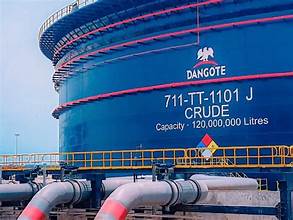
The Dangote Refinery, which currently refines 650,000 barrels of oil per day, is preparing to more than double its output to about 1.4 million barrels per day. This expansion would make it the largest refinery in the world, surpassing India’s Jamnagar facility, which produces 1.36 million barrels per day.
Aliko Dangote, President and Founder of Dangote Industries Limited (DIL), revealed in an interview with S&P Global Commodity Insights that the management of the $20 billion refinery and petrochemical complex is considering a shift in its business structure. The company plans to list as much as 10 percent of its shares on the stock exchange by next year.
The 68-year-old industrialist described his ambition to achieve energy independence for Africa as a challenging but deeply personal mission, emphasizing that it is a “labour of love.” He explained that such large-scale investments are necessary because African governments are generally unwilling to fund projects of this magnitude.
“We have to build the refinery again, either here or somewhere else,” Dangote said. “But building it elsewhere isn’t realistic because we would need to spend a lot developing new infrastructure, while everything we need is already in place here.”
Projections from S&P Global Commodity Insights indicate that Nigeria’s net petrol imports could more than double between 2026 and 2027, reaching nearly 200,000 barrels per day by 2030. This growth is expected to be driven by continued economic development and rapid population increases.
In July, Dangote announced plans to expand refinery capacity from 650,000 to 700,000 barrels per day by the end of the year. The company has now set a larger goal of reaching 1.4 million barrels per day, though no timeline has been provided for achieving it.
Engineers at the Lekki site explained that the complex was designed to allow for future expansion. They pointed to empty concrete plots capable of accommodating another full refining system. The Dangote Group, now Nigeria’s largest private power producer, already generates twice the electricity it consumes, ensuring steady operations even during nationwide power shortages.
According to one engineer, the expansion could involve building a second refinery with a similar configuration and possibly adding a vacuum distillation unit to improve light product yields. The S&P report also noted that this design flexibility was part of the refinery’s original blueprint.
Dangote stated that the company is pursuing additional projects, including potential developments in linear alkylbenzene and base oils. It also plans to raise its annual polypropylene output from 1 million metric tons to 1.5 million metric tons over the next few years.
Rejecting the notion of Africa’s continued dependence on imported fuel, Dangote reaffirmed his goal of transforming the continent’s energy sector. He expressed skepticism about government-led initiatives and warned that Africa could face severe challenges without large-scale private sector investment.
“Most African governments do not have the means to build refineries,” Dangote said. He described smaller plants such as Angola’s new Cabinda refinery as “a drop in the ocean,” suggesting that much larger projects are needed to make real impact.
He also highlighted the high cost of financing in Africa, noting that interest rates can reach 30 percent in some countries, with inadequate infrastructure adding to the challenges of project development.
The report mentioned that Dangote Industries had faced pressure from maturing debts, which posed a major obstacle to further expansion. However, this issue was resolved in August after securing a crucial $4 billion financing agreement.
Dangote confirmed that the company is considering forming strategic partnerships with firms in the Middle East to support the refinery’s growth and develop a new petrochemical project in China. He said the company’s ownership model is evolving, with plans to invite other investors instead of maintaining full control.
Within a year, Dangote plans to list between 5 and 10 percent of the refinery’s shares on the Nigerian Stock Exchange, following the same strategy used for the group’s cement and sugar businesses.
He explained that Dangote Industries intends to retain around 65 to 70 percent ownership, with additional shares offered gradually depending on investor interest and market strength.
Dangote also noted that the Nigerian National Petroleum Company Limited (NNPC) could increase its stake in the refinery, though such discussions would only happen after the next phase of growth is complete. NNPC currently holds a 7.2 percent share.
“I want to show what the refinery can achieve first before we talk,” Dangote said. A close associate, speaking anonymously, told S&P that the company will proceed cautiously before considering any further NNPC involvement.
Despite the refinery’s ambitious expansion plans, it continues to manage operational challenges. The report stated that the Residue Fluid Catalytic Cracker (RFCC), the refinery’s main petrol-producing unit, went offline in September following a three-week turnaround in August, leading to speculation about future maintenance downtime.
Devakumar Edwin, a Vice President overseeing operations, confirmed that the RFCC resumed production around October 7 and is expected to return to full capacity soon.
Dangote acknowledged that most of the technical issues have been resolved, although some remain. He added that the company is preparing for another maintenance shutdown of about a month to complete additional work.
The planned one-month maintenance will affect the RFCC but not the Crude Distillation Unit (CDU) or other secondary systems. According to Edwin, a complete shutdown of the refinery is only required every five years. Dangote said that the upcoming RFCC maintenance will be scheduled to avoid Nigeria’s year-end fuel demand surge, though he did not give specific dates.
The company also cited internal sabotage as a potential operational risk, which led to the dismissal of 800 employees in September and a brief strike. After government-led negotiations, Dangote Industries pledged to reassign all affected workers, mostly to other parts of the business.
Dangote expressed confidence that union tensions have been resolved and stated that the reorganization is nearly complete, reducing the likelihood of future disputes.
As the refinery expands, sourcing crude oil remains a major challenge. Dangote confirmed a key agreement with NNPC that will help ensure a stable supply of feedstock.
Under the current “crude for naira” arrangement, NNPC provides Dangote with 14 cargoes of crude or the equivalent value in dollars, while receiving the same amount of petrol and diesel in Nigerian currency.
In addition, the company’s upstream assets in Nigeria’s Niger Delta—Oil Mining Leases 71 and 72—are expected to start producing soon, with output projected to reach up to 40,000 barrels per day.
Dangote said he is also exploring new upstream ventures to strengthen the company’s energy portfolio. Recent investments by the Dangote Group include a major fuel storage terminal in Namibia, a fertilizer plant in Ethiopia, a fleet of 4,000 compressed natural gas trucks, and a potential energy project in Senegal.
source:www.thisdaylive.com

 African Energy Council