
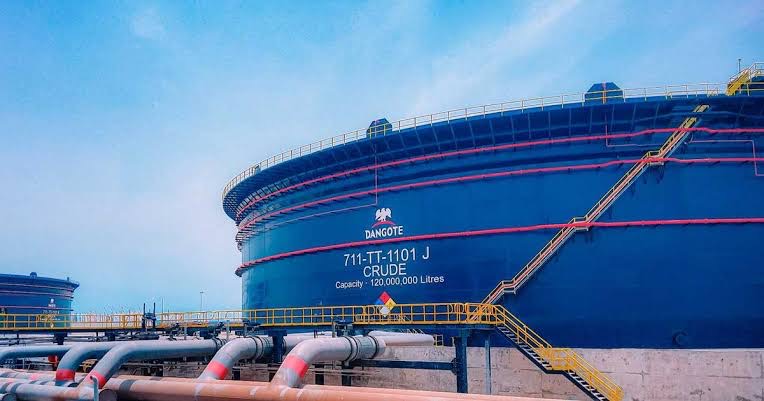
The Dangote Petrochemical Refinery is set to bring in over five million barrels of crude oil during July.
Reuters reports that this shipment consists of U.S. West Texas Intermediate (WTI) crude.
The refinery awarded contracts to import about 161,000 barrels of WTI daily throughout the month.
However, the final monthly total could rise if additional contracts are made.
In June, the refinery made its largest single-month WTI purchase, securing roughly 300,000 barrels per day.
The refinery will continue its large-scale imports, with at least five million barrels expected from the U.S. in July.
Sources revealed that the plant has secured about 161,000 barrels per day for July, building on the record-setting June imports.
The refinery, located in Lagos and capable of processing 650,000 barrels daily, has increasingly relied on foreign oil to maintain operations.
Edwin Devakumar, the refinery’s Executive Director, acknowledged the need to import crude since local supply remains insufficient.
Three sources told Reuters that Vitol will deliver two million barrels in July, with Socar and Glencore contributing two million and one million barrels, respectively.
While Nigerian crude remains the refinery’s main input, Dangote has consistently sourced WTI since March 2024.
The company also acquired crude from countries like Angola, Equatorial Guinea, Algeria, and Brazil.
Kpler shipping data shows the refinery reached a previous import peak in April, bringing in 173,000 barrels per day from the U.S.
Rising U.S. imports reflect changing global oil trade patterns.
With lower demand in Asia and falling premiums for UAE’s Murban crude, U.S. producers are now targeting African markets like Nigeria.
Due to technical challenges, the refinery will continue to operate below full capacity until at least October, according to IIR.
A refinery spokesperson told Reuters that output is ramping up to 85 percent, or about 552,500 barrels per day.
Since mid-March, IIR has tracked the plant running at roughly 80 percent capacity.
Meanwhile, Nigerian oil and gas firms expanded their bank borrowing by N3.25 trillion between December 2023 and December 2024.
CBN data reveals that credit to the sector rose from N8.36 trillion to N11.61 trillion over the year, marking a 38.8 percent increase.
This credit surge comes alongside over $8 billion in new investments secured for deepwater oil and gas projects.
Reforms under the Tinubu administration played a key role in attracting these investments.
Final Investment Decisions supported projects like Shell’s Bonga North and TotalEnergies’ Ubeta development.
According to the CBN’s bulletin, loans to oil and gas firms jumped to N12.31 trillion in January 2024.
The figure peaked in February, reaching N13.32 trillion in total outstanding credit.
March saw a slight drop to N10.99 trillion, but credit levels began rising again in April and May.
In June, lending dipped slightly to N11.97 trillion, before rebounding to N12.81 trillion in July.
This upward trend continued in August and September, when loans reached N13 trillion.
Credit slightly declined in October and November, with totals dropping to N12.97 trillion and then N12.74 trillion.
By December 2024, lending to the sector settled at N11.61 trillion—marking a net gain of N3.25 trillion over the year.
The CBN also ramped up foreign exchange support for oil refining, increasing disbursements from $82 million in 2023 to nearly $190 million in 2024.
The disbursements broke down into $40 million in Q1, $47.25 million in both Q2 and Q3, and $55.43 million in Q4.
source: punchng.com

 African Energy Council